
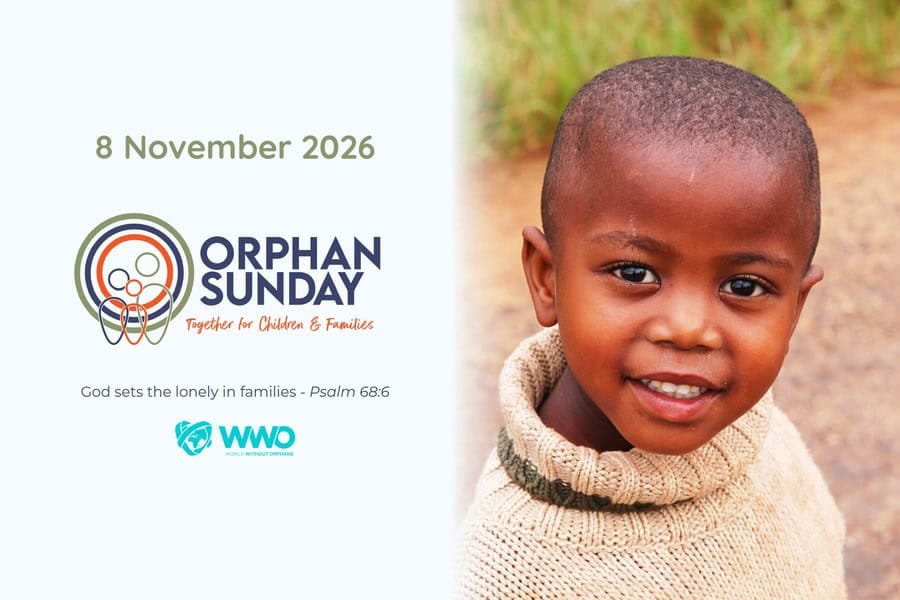
Churches around the world are being invited to mark Orphan Sunday on 8 November, or on another Sunday that fits their local calendar, by praying for vulnerable children and helping them grow up in safe, loving families. The observance is promoted by World Without Orphans (WWO), whose toolkit for congregations offers prayer guides, videos, devotionals, social media materials and practical ideas. This year's theme is "Pray and Care. Together for Children and Families." The World Evangelical Alliance (WEA) is backing the initiative through its Children's Network.
Rebecca Goropevsek, co-coordinator of the WEA Children's Network, said churches have a significant role to play because they are present in almost every community, know the families around them and are trusted. "Few are better positioned to notice a family under strain, walk alongside caregivers and offer support that lasts," she said. She added that through Orphan Sunday churches can start with small, practical steps — raising awareness, supporting families, encouraging caregivers and inspiring others to get involved.
The observance began in 2002 in Kalingalinga, a community in Lusaka, Zambia, where Pastor Billiance Chondwe drew on James 1:27 and called his congregation to care for the orphans and widows around them. Although many members were poor themselves, they brought food, clothing and shoes for children in need. An American visitor, Gary Schneider, helped coordinate Orphan Sunday across Zambia and shared the vision with churches in the United States, where the observance arrived in 2003 with support from Every Orphan's Hope and other organisations. The Christian Alliance for Orphans began coordinating it in 2009, and organisers say it is now observed in more than 100 countries.
In Ukraine, Orphan Sunday helped mobilise thousands of churches on behalf of children. Andrii Fedun, WWO's events and communications lead in Ukraine, told a recent WEA Children's Network webinar that more than 6,000 churches across denominations took part in the first year of a day of prayer about 15 years ago, and more than 18,000 the next. "The real story wasn't the number. It was unity," he said. A similar movement began in Jordan, where Nisreen Hawatmeh, now WWO's regional ambassador for the Middle East and North Africa, helped organise the first Orphan Sunday there in 2017 with four churches; from Jordan it spread to Syria, Egypt, Iraq, Sudan, Uganda, Kuwait, the United Arab Emirates and the West Bank, with Lebanon joining in 2025.
WWO's vision is for every child to grow up in a safe, loving family and community. Churches can help keep families together by supporting parents and caregivers, encouraging foster and adoptive families and helping prevent unnecessary separation; where children cannot safely remain with their birth families, churches can support appropriate family-based care. On Orphan Sunday a congregation might hold a prayer service, help a family in crisis, support foster or adoptive parents or partner with organisations that serve children.
Source: World Evangelical Alliance (WEA) — worldea.org/orphan-sunday-2026/


