
The free evangelical movement is a global family of national church federations, local congregations, and mission agencies that share a common theological DNA: believers’ church ecclesiology, the alliance principle of essentials-unity and secondaries-liberty, and a conviction that personal faith in Christ — rather than birth, nationality, or inherited tradition — is the only condition of belonging.
It is not a denomination in the usual sense. There is no central headquarters that governs it, no single confession that all its members have signed, no pope or presiding bishop. What holds it together is more like a shared instinct, developed through three converging streams of nineteenth-century Protestant renewal, institutionalised in a network of national federations, and now spanning every inhabited continent.
Three streams, one river
Three distinct renewal movements fed into what became the free evangelical tradition. Each brought something the others needed.
The revivalist stream, running from Jonathan Edwards and George Whitefield in the eighteenth century through John Wesley, Charles Finney, and the great awakening movements of the nineteenth, insisted on the necessity of personal conversion. You could not be a Christian by proxy or inheritance. Faith had to be your own. This conviction — that the church is properly a community of the personally converted — became the ecclesiological foundation of the believers’ church.1
The holiness stream, most influentially the Keswick movement in Britain, pressed the revivalist insight further: conversion was the beginning, not the destination. The Christian life was a life of ongoing sanctification, empowered by the Holy Spirit for witness and service. Keswick-movement teaching spread across Europe in the 1870s and 1880s, carried by networks of evangelists and prayer meetings that crossed national and denominational lines.2
The alliance stream contributed the operating principle that tied revivalism and holiness together for cooperative work across doctrinal lines: in essentials, unity; in secondary matters, liberty; in all things, love. The Evangelical Alliance, founded in London in 1846, demonstrated that Christians who disagreed about baptism, polity, and eschatology could nonetheless plant churches together, run seminaries together, and send missionaries together — because they agreed on what was actually non-negotiable. This alliance logic became the organisational architecture of the free evangelical movement, and it remains its most distinctive contribution to the wider Christian world.
How it organised itself
The free evangelical movement took national institutional form across Europe through the second half of the nineteenth century and into the twentieth. In Germany, the Bund Freier evangelischer Gemeinden (FeG) has roots going back to 1854. In Scandinavia and across Northern and Central Europe, free evangelical and mission covenant churches developed in parallel, shaped by the same revival currents but with distinct national characters. In Switzerland, the Netherlands, Spain, and across Central and Eastern Europe, national federations formed with similar theological convictions but considerable local variation.
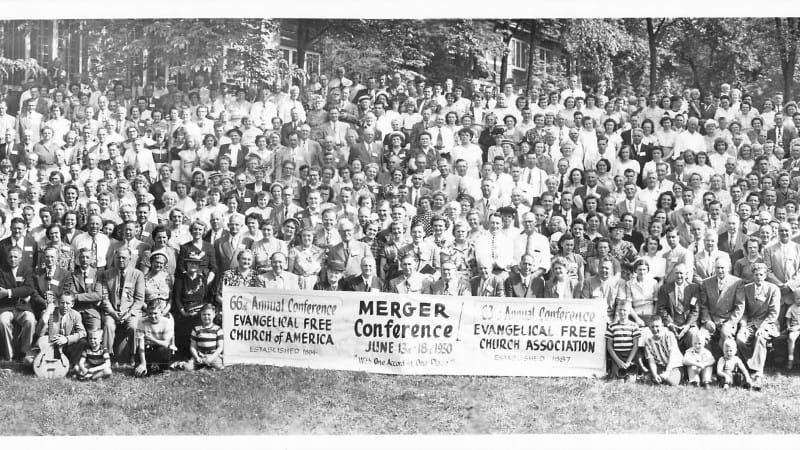
In North America, the same stream produced the Evangelical Free Church of America (EFCA, formally constituted in its current form in 1950) and the Evangelical Covenant Church (ECC), both tracing their origins to Scandinavian immigrant communities who brought the free evangelical ecclesiology with them.3
Internationally, these national federations came together after the Second World War in the International Federation of Free Evangelical Churches (IFFEC), founded in Bern in 1948. IFFEC currently links thirty-one national member federations plus associate members and regional associations, with combined mission engagement in more than sixty countries. Its constitutional basis is the believers’ church principle: personal faith in Jesus Christ is the only condition of membership in a local church. Africa is conspicuously underrepresented in IFFEC’s current membership map, though several African national churches have been planted by IFFEC-member mission agencies and exist in informal relationship with the family.
What holds it together
The movement’s coherence is theological more than organisational. Three convictions recur across its national expressions in different languages and cultural settings.
First, the church is constituted by personal faith. Membership is voluntary, confessional, and subject to genuine discipline — which means it is also genuinely meaningful. A congregation of the personally converted is not a sociological given; it is an ongoing achievement that requires formation, accountability, and mutual care.
Second, the local congregation is the primary ecclesial reality. National federations serve the congregations; they do not own them. This produces a movement that is structurally decentralised and therefore resilient, capable of taking root in very different national and cultural contexts without requiring a uniform liturgy, a centralised property portfolio, or an episcopal appointment system.
Third, the movement’s reason for existing is mission. The free evangelical tradition has never been primarily a preservation project. Its founding logic, wherever it emerged, was the awakening and preserving of living Christian faith among people who did not have it. This missional orientation has expressed itself in church planting, in theological education, in Bible translation, in mercy work, and in the kind of networks that connect national movements to one another without absorbing them into a single institutional structure.
A family still growing
The free evangelical movement is not finished or fixed. Its under-representation in Africa and parts of Asia reflects historical accident as much as theological reality — church networks in several countries share the believers’ church ecclesiology and the alliance disposition without (yet) having formal connection to the global free evangelical family. The movement’s own constitutional architecture, through IFFEC, includes an explicit open door for new national federations seeking membership.
What the movement is, at its best, is a tested answer to the question of how Christians who are serious about doctrine can nonetheless work together across the lines that divide them. It is not the only answer the Christian tradition has produced. But it is a coherent one, with a hundred and fifty years of institutional practice behind it.
See also: What is a free evangelical church? | Alliance thinking | Main free evangelical bodies | Free evangelical and Alliance churches
- On the revivalist roots of the believers’ church tradition, see David Bebbington, Evangelicalism in Modern Britain: A History from the 1730s to the 1980s (London: Unwin Hyman, 1989), chaps. 1–2.↩︎
- On the Keswick movement and its continental spread, see Charles Price and Ian Randall, Transforming Keswick (Carlisle: OM Publishing, 2000).↩︎
- On the EFCA and ECC origins in Scandinavian free-church immigration, see Karl A. Olsson, By One Spirit: A History of the Evangelical Covenant Church (Chicago: Covenant Press, 1962), and Arnold T. Olson, Believers Only: An Outline of the History and Philosophy of the Evangelical Free Church of America (Minneapolis: Free Church Publications, 1964).↩︎