
The Evangelical Covenant Church of Canada traces its beginnings to 1874, when two Swedish immigrants, Monsby Peterson and Reader Johnson, stepped off a boat in Winnipeg, Manitoba — then a frontier town of barely 1,500 people — looking for community. They found other Scandinavian newcomers, and they began to gather to pray and read Scripture wherever they could. Those gatherings came to matter so much that Peterson quit his job on the railway in order to stay near the group. By 1885 the believers needed a permanent home, so Peterson bought a house and gave it to the fledgling movement, which a year later joined the Swedish Evangelical Mission Covenant of America.
Today that movement is the Evangelical Covenant Church of Canada (ECCC) — one of eleven conferences in the Covenant family, yet also its own denomination under Canadian law. It counts thirty-one churches, four camps and a set of foundations and affiliates, scattered across a country where congregations can sit thousands of miles apart. The Rev. Rob Peterson, elected president and superintendent in the spring of 2025, describes his calling as “a steward of our shared mission and shepherd for churches,” and tells his staff to “keep the focus on the relational capital we have and steward these relationships well.”
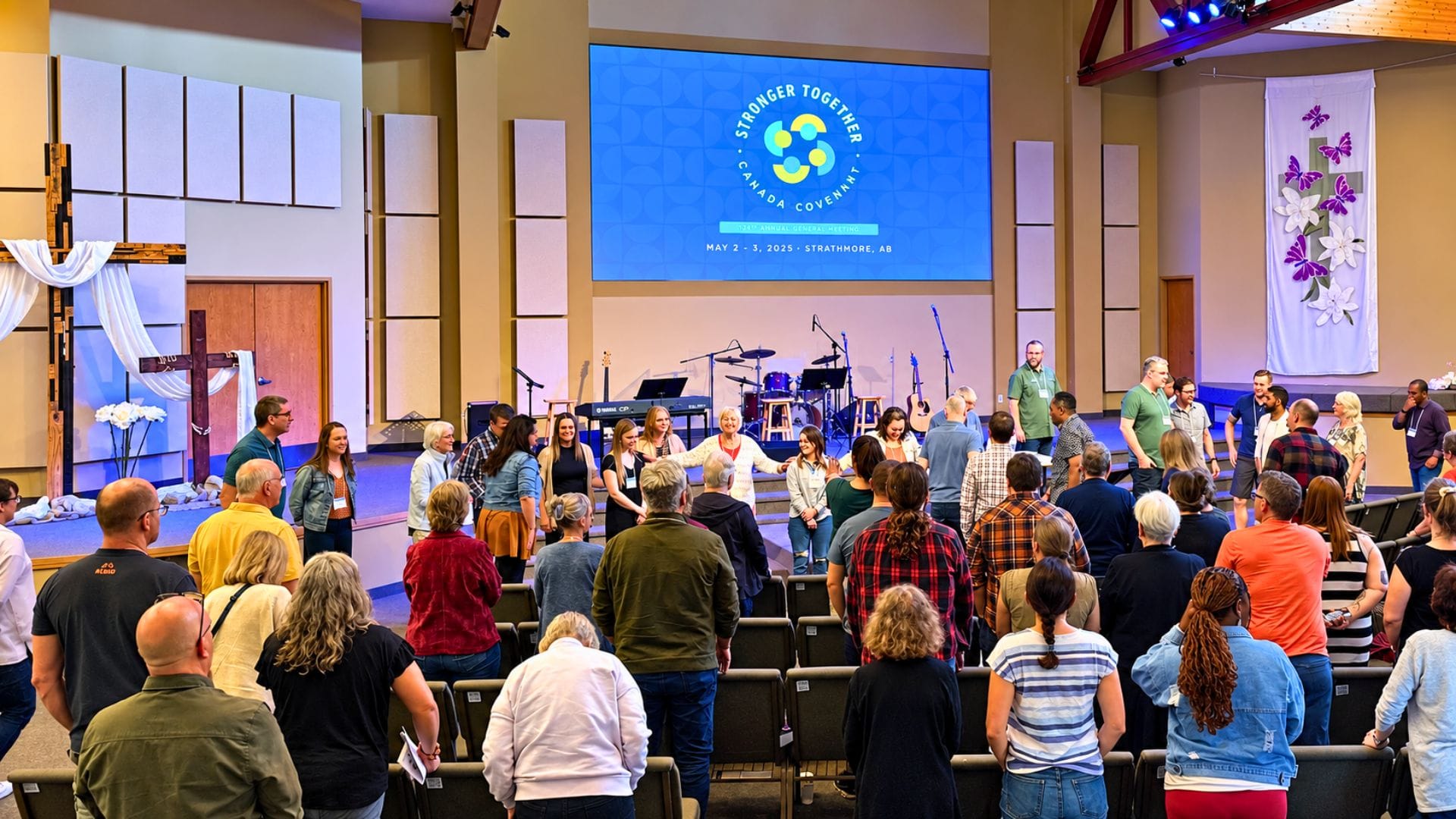
That distance shapes how the conference works. Rick Penner, lead pastor of Lighthouse Community Church in Sarnia, Ontario, says the Canada Covenant feels less like “some kind of a distant board or denomination oversight” than a family. The annual general meeting is the one event the whole family shares, and it draws reliable turnout partly because gathering everyone costs real money. The conference has experimented with rotating regional retreats for pastors, and the board has floated more localised events and perhaps an unpaid “regional pastor” for provinces such as Alberta or Manitoba. “I don’t think we’ve found a sweet spot yet,” Peterson says. “We’re still experimenting.”
Church planting has turned decisively eastward. For most of its history the Canada Covenant was a western story, following the rail lines as missionaries served scattered Swedish communities across the prairies. Fifteen years ago the conference deliberately turned toward the greater Toronto area, home to roughly 15 percent of Canada’s population; it planted its first church there in 2012, and most of its newest congregations are now concentrated in Toronto and across southern Ontario. Andy Sebanc, who has pastored Green Timbers Covenant Church in the Vancouver area for nineteen years, has watched his congregation — which averaged eighty-five years of age when he arrived — reshaped by waves of immigration from India and Taiwan and, more recently, from Cameroon and Congo. Its stated vision is now to be “a multicultural, multigenerational, Christ-centered community.”
The relational emphasis shows in the smaller details. When Eddy Lee, who left a Korean Presbyterian denomination in search of a body that cared more about mission than polity, launched Encounter Covenant Church in November 2019 — four months before the pandemic — the then-superintendent Glenn Peterson began checking in on him personally and helped him find a spiritual director so he would not feel alone. Six years on, Rob Peterson keeps the same rhythm, reaching out every other month.
Source: Evangelical Covenant Church / Covenant Companion — covchurch.org


