
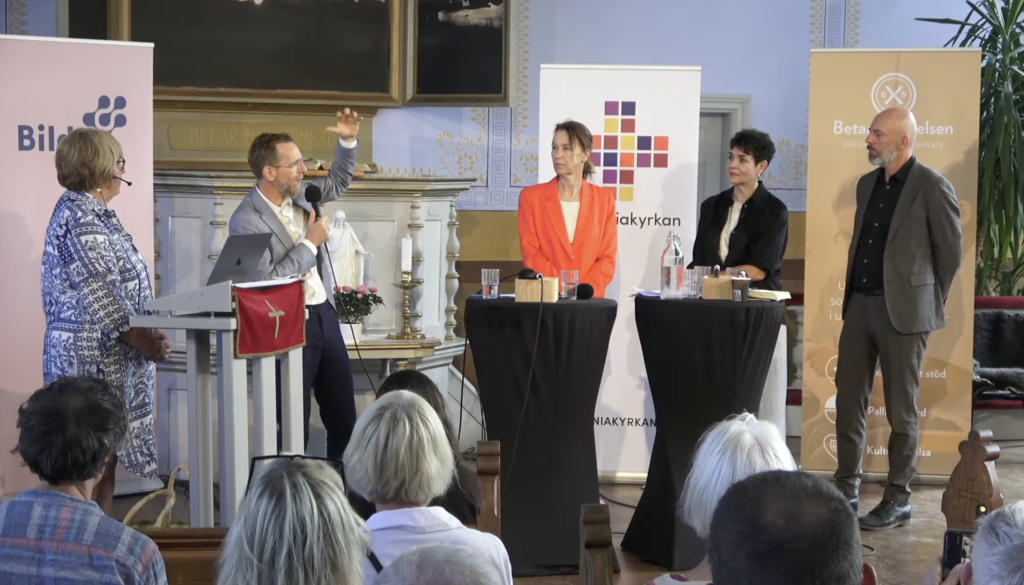
Beneath Sweden’s polarised public debate over existential health — dismissed by some as woolly thinking while others point to rising mental illness — a broad consensus is taking shape among researchers, public health officials, and government leaders. At a seminar during Almedalen Week in Visby, Social Minister Jakob Forssmed, Public Health Agency director-general Olivia Wigzell, and several leading academics agreed that loneliness, meaning, and human belonging are concrete public health concerns that cannot be addressed by healthcare alone.
Forssmed told the gathering that the debate has been overdramatised, pointing to clear research showing young people increasingly feel life lacks meaning. “The state cannot of course tell people what the meaning of life is,” he said, “but public institutions must understand that meaning matters for health.” He emphasised the indispensable role of civil society — sports clubs, cultural associations, study circles, and faith communities — and warned against the replacement of face-to-face encounters with screen-based life. Recounting conversations with adults in their thirties about what they needed at sixteen, he noted that almost none mentioned shorter queues for psychiatric care. “I needed an adult who told me: it’s going to be okay,” was the most common answer.
David Thurfjell, professor of religious studies at Södertörn University, challenged the minister directly to protect the spaces where people actually encounter one another — folk high schools, study associations, and churches. Meaning, he argued, does not come from being free but from being connected: to a football team, a choir, a congregation, or a local community where one is genuinely needed. Olivia Wigzell of the Public Health Agency stressed that existential health is not primarily a healthcare question — people themselves identify relationships, nature, and belonging to something larger as their deepest sources of meaning. Ulla-Karin Nyberg, a psychiatrist at the Karolinska Institute, added that existential health is not about the absence of illness or suffering but about finding a balance between hardship and possibility. Across the panel, the unifying theme was that society creates the conditions for meaning not through top-down programmes but by protecting and valuing the local communities where people are seen and taken seriously.
(Originally published in Swedish. Summary translated by CC / Connexion.)
For free church formation resources including this topic, visit Worldwide Evangelical Seminary.
Source: Equmeniakyrkan / Sändaren — sandaren.se


