
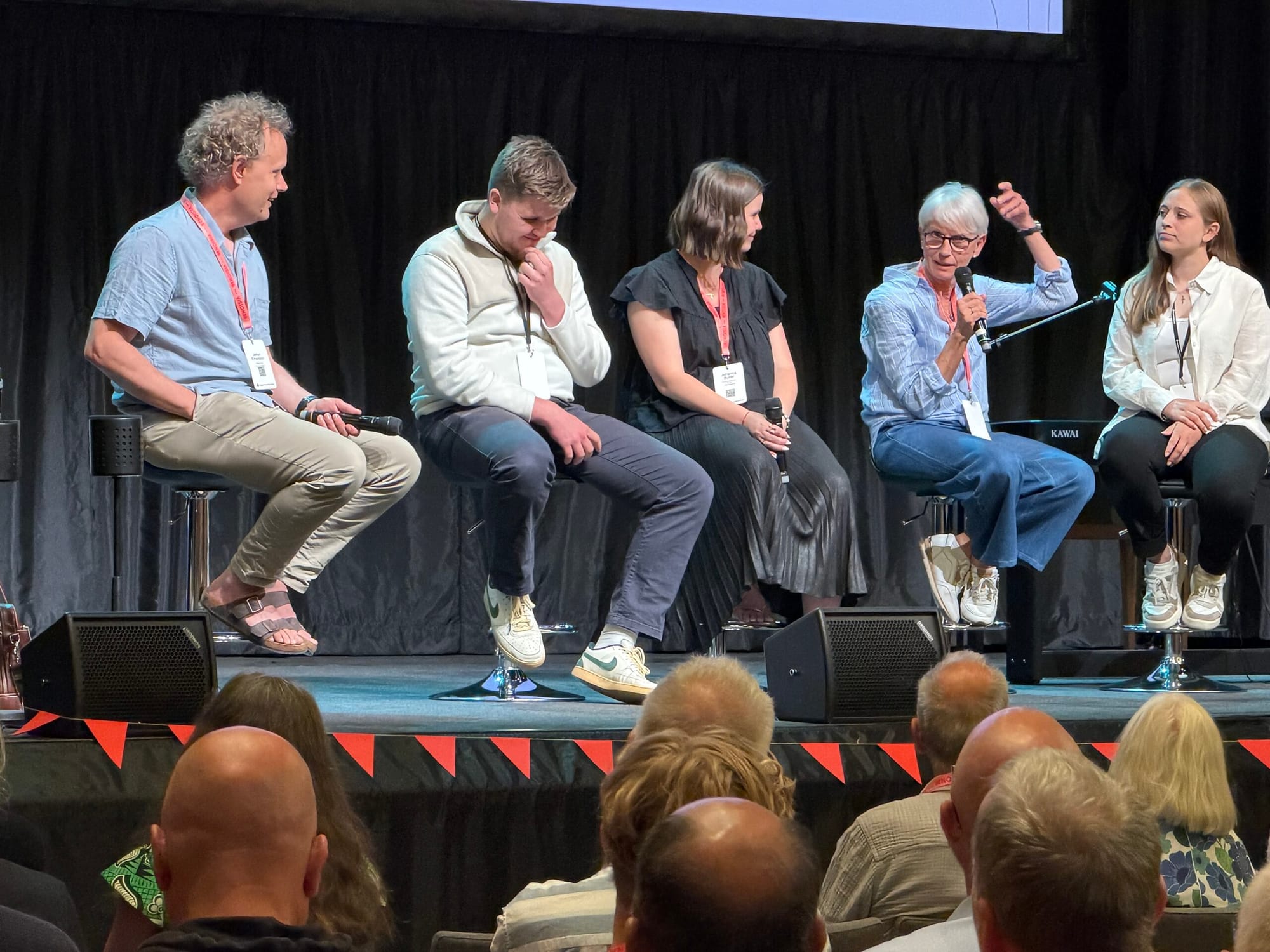
Half of the Equmeniakyrkan's congregations have 50 members or fewer, and half lack any employed staff. When the denomination's first Vision Conference gathered in Örebro, the conversation was therefore less about success formulas and more about something else: how to keep praying, keep trying new paths, and keep reaching people — without letting the fear of decline become the driving force.
Four panellists from widely different contexts took the stage before a packed hall: Johanna Buller, pastor in Borås; Hugo Magnusson, evangelist in Mjölby; Susanna Ehlde, one of those building Vidakyrkan in Örebro; and Mildred Persson, chair of the small congregation in Berga outside Oskarshamn. At first glance their stories looked very different. Yet together they described a reality likely familiar to many Equmeniakyrkan congregations: limited resources, few co-workers, and a constant need to find new ways forward.
Toward the end of the seminar, regional church leader Johan Einarsson put numbers to the reality. "Fifty percent of Equmeniakyrkan's congregations have fifty members or fewer," he noted. The Vision Conference, which drew over 1,300 participants including children, was structured around small-group conversation rather than plenary lectures — a deliberate design choice reflecting the conviction that renewal emerges from honest local dialogue rather than top-down strategy. The message that emerged was clear: facing decline honestly, without being driven by fear, is itself an act of faith.
(Originally published in Swedish. Summary translated by CC / Connexion.)
For free church formation resources including church planting and congregational renewal, visit Worldwide Evangelical Seminary.
Source: Equmeniakyrkan / Sändaren — sandaren.se


