
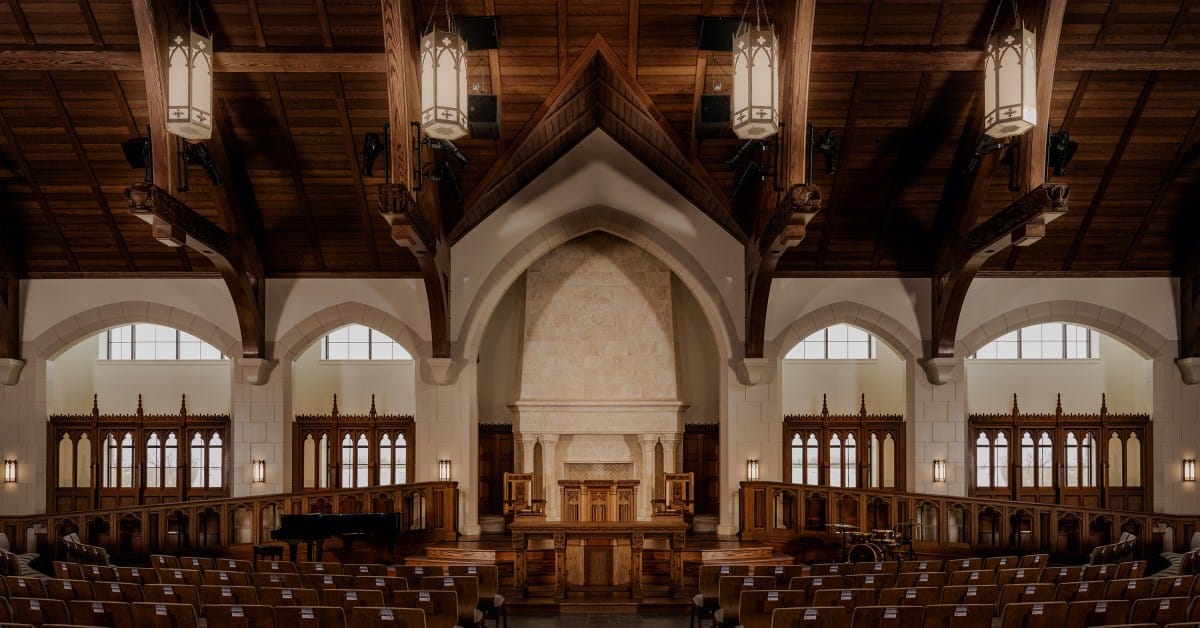
After decades in which new church buildings were designed to look like anything but — boxy auditoriums, sparse stages, warehouse-chic exteriors — a number of congregations are building and renovating worship spaces that look unmistakably like churches. Writing for Christianity Today, Rabekah Henderson describes a quiet turn toward arches, stained glass, carved beams and sanctuaries arranged around the pulpit and the font.
Trinity Presbyterian in Owasso, Oklahoma, met in twelve different places — including a YMCA and a middle school — before it built. Its new worship hall has pointed arches, gently sloping stone floors and twelve hammerbeam trusses carved with scenes from Scripture, from Daniel in the lions' den to the wedding at Cana. The pulpit, not an altar, is the focal point, and the rood screen is pushed back against the windows so that nothing separates the pastor from the congregation. Senior pastor Blake Altman says the space brings "truth, beauty, and goodness together in a physical space" and "helped make us biblically literate again." The design, Henderson notes, walks a line familiar to Reformed churches — wariness of imagery becoming idolatry, alongside a conviction that beauty can point people to truth.
At St Timothy's Episcopal in Winston-Salem, North Carolina, the renovation began with a question from a guest at the church's shelter, who asked why there was a birdbath at the back. It was the baptismal font, and the rector, Fr Steven Rice, realised the building was not communicating what the church believed. Rather than modernise, the congregation expanded the baptistery, altar and choir loft, and added a large triptych modelled on the work of the 15th-century painter Rogier van der Weyden. "A church of beauty is an invitation," Rice says, "and it belongs to all people."
The trend is not confined to historic denominations. Jesus Image Church, a charismatic megachurch in Orlando, is building a sanctuary with stained glass and wooden beams; Bent Tree Bible Fellowship in Carrollton, Texas, built a chapel with warm textures and natural materials for its growing Spanish-speaking congregation. Architect Matthew Alderman, who has lectured for years on "why every new church looks like a Sam's Club," sees a desire, especially among younger congregants and clergy, to worship in a building "that looks like a church." A 2022 Barna study found that 62 percent of Christians believe a church building should stand out as a church rather than blend in, and that about 80 percent of Americans think a church should reflect the beauty of God.
Henderson is careful about the limits. For many smaller congregations, especially in the United States, a capital-heavy building project is simply out of reach, and some churches feel convicted to put their resources into missions or outreach instead. Both pastors she interviews insist that their buildings are not the church; Acts 7:48 says that God does not dwell in temples made with human hands. But the spaces still shape worship, she argues, and a little thought about the arrangement and intention of a sanctuary can go a long way. "Architecture speaks," Altman says, "so we wanted to tell the gospel."
Source: Christianity Today — christianitytoday.com


