
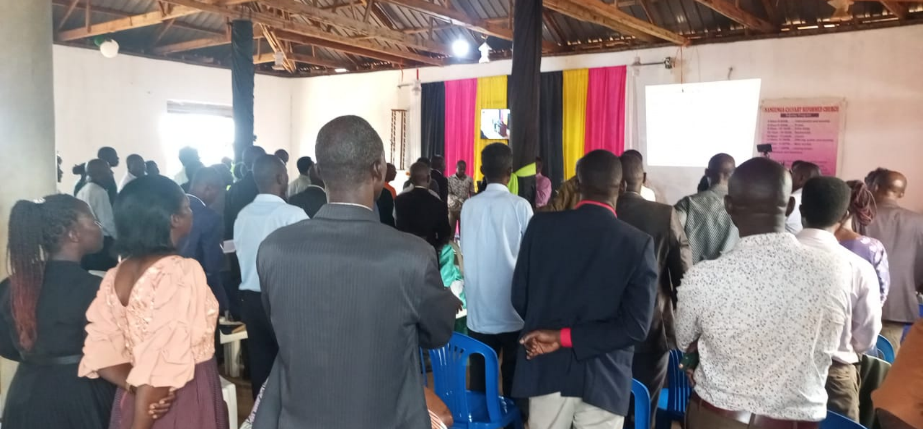
As Uganda debates who may lead a church, pastor and teacher Eria Ssekandi is trying to get pastors trained before any new rules take effect.
In March 2026, Uganda's Chief of Defence Forces, General Muhoozi Kainerugaba, posted on X that if the Patriotic League of Uganda (PLU) takes power, "fake pastors" and unregulated churches could face arrest. He added that anyone leading a church should hold at least a degree in theology.
In Buikwe, central Uganda, Pastor Eria Ssekandi has watched what followed. "Because of the impending policies," he writes, "pastors and church leaders are seeking formal and credible theological education like never before in this country."
A policy long in the making
Uganda's plans to regulate religious groups are often traced to the March 2000 fire at Kanungu, where more than 700 members of a religious movement died. Around 2016 the government's ethics and integrity office began drafting a National Policy on Religious and Faith-Based Organisations. The draft would require places of worship to be cleared by local security officials and organisations to declare their domestic and foreign funding. In the version church leaders have discussed, it would also require pastors to hold formal theological training.
Enforcement has so far been inconsistent. In November 2019 the government ordered nearly 12,000 NGOs, including many churches, to close after a validation exercise in which only 2,119 of 14,027 registered organisations passed. Church leaders said the order violated freedom of worship, which Article 29 of the Constitution guarantees.
Neighbouring Rwanda shows where such a policy can lead. In 2018 it began requiring pastors to hold a theology degree, and in 2024 authorities inspected more than 13,000 places of worship and closed thousands that failed legal and operational requirements. (See our companion report from Rwanda.)
Uganda's policy remains a draft, and governments have historically moved cautiously, partly because the Born-Again movement is a large political constituency. But the numbers explain why church leaders are worried. Estimates in Ugandan media suggest that around 90 percent of Pentecostal and Born-Again pastors have no formal theological qualification.
Scrutiny arrives in small ways
Scrutiny of small churches is already arriving, sometimes in mundane forms. Earlier this year, town council health officials told Ssekandi's congregation to build a pit latrine or face closure, and a new council leadership was expected to enforce the rules strictly. A project donation from Finland covered the cost, and the latrine now stands. For thousands of small congregations, though, the harder test will be the qualifications of their leaders.
Churches as classrooms
Ssekandi served in Kasubi, a suburb of Kampala, from 2003 until April 2024, when he moved to rural Buikwe to plant Christian Wisdom Church. He also teaches for Missioners Theological College, a Ugandan branch of Worldwide Evangelical Seminary (WWES). Rather than build campuses, he teaches in local congregations. "I primarily work with Churches as teaching centers," he writes.
His motivation goes deeper than compliance. "Many false doctrines are eating up our churches in Uganda," he says. "Many leaders here do not know what to do." Church leaders, he argues, need sound teaching so they can protect their people. That concern is also one of the government's own arguments for regulation.
Pastors across Uganda are now offering their churches as teaching centres, and Ssekandi wants to train as many as possible before any harsh rules take effect. Two ordinary obstacles hold him back. Fuel costs limit how often teachers can reach rural centres, and students cannot afford printed materials to keep for study once a course ends.
An open question
No one yet knows which training Uganda would recognise. The National Council for Higher Education sets degree standards, and some accelerated certificates and online diplomas from unaffiliated foreign ministries may not meet them. In Rwanda, according to one training ministry there, certificates from unapproved foreign institutions were not accepted.
WWES provides education, not licences for ministry. Study through Missioners Theological College does not by itself settle whether a future Ugandan rule would recognise it. What it offers while the rules remain unwritten is local, Scripture-based teaching for pastors who would otherwise have none.
Next: Kenya
Ssekandi will attend the IFFEC Worldwide conference at Brackenhurst, Kenya, opening on 28 September, as an observer alongside other African Free Evangelical leaders. His request to the worldwide Free Evangelical family is simple: help reaching pastors who cannot afford to travel, and study materials they can use offline and keep after their graduation.
Interested in the work of Worldwide Evangelical Seminary? Learn more at WWES. This story draws on Eria Ssekandi's written accounts of his ministry (March and September 2026), a photograph he supplied, and reports from New Vision, AllAfrica and Religion Unplugged.


