
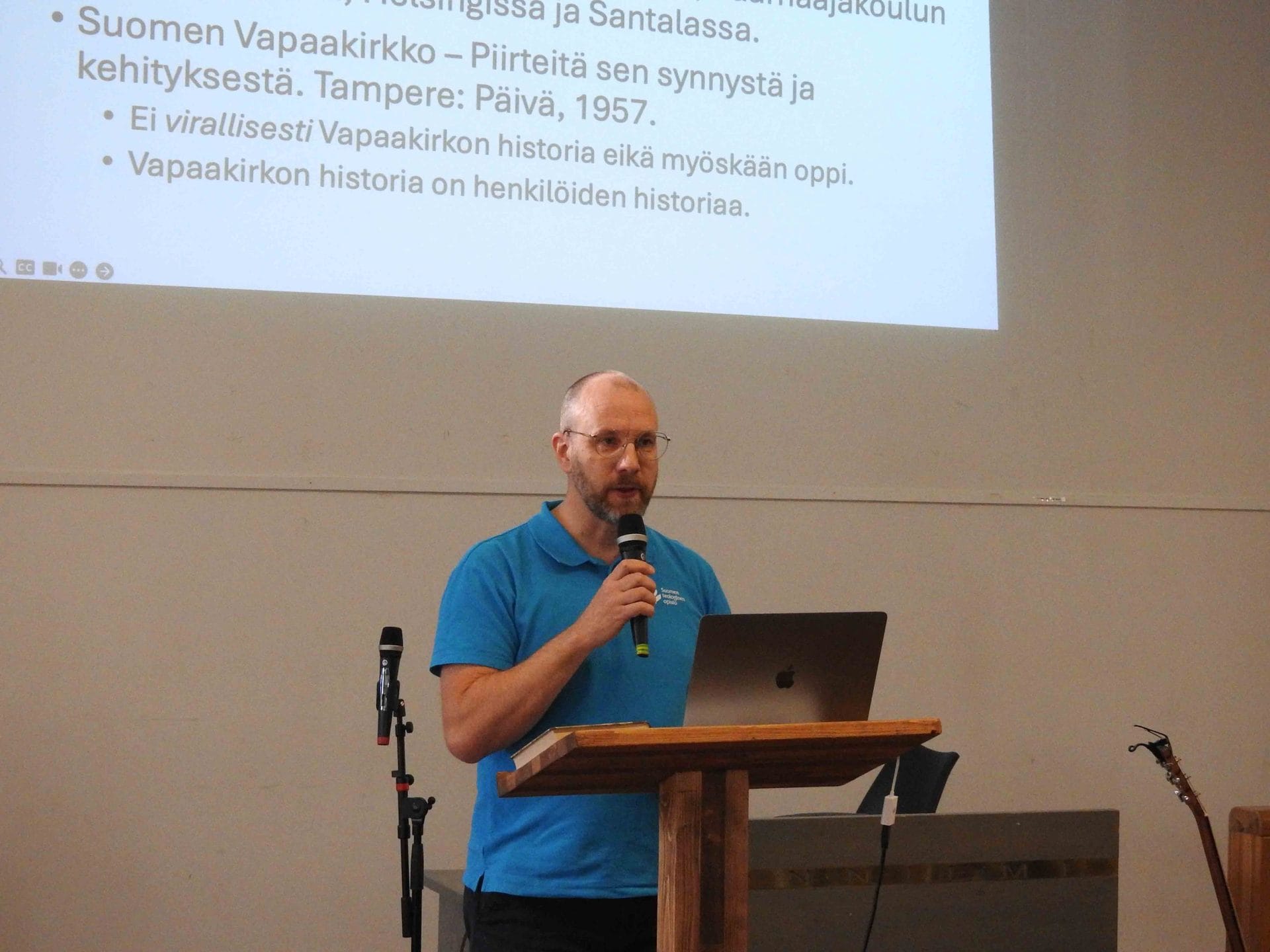
What is the identity of the Finnish Free Church, and what kind of church does each of its members want to help build? Those questions framed a lecture by Tommi Karjalainen, a teacher at Suomen teologinen opisto (the Finnish Theological Institute), who turned to the writings of Sulo Santeri Salmensaari and his book Suomen Vapaakirkko – Piirteitä sen synnystä ja kehityksestä (The Finnish Free Church: Features of Its Origin and Development), published in 1957.
Karjalainen's central emphasis was confessional: "The Free Church is not a confessional church — it is bound by Scripture," he said, noting that Salmensaari was already observing in 1957 that members might disagree on certain matters. The book, he said, describes candidly the harmful doctrinal missteps of the holiness movement and their unhappy consequences, and treats Pentecostalism and its charismatic features in a less favourable light; Baptism and Methodism are even named as harmful, on the grounds that they could not grow into significant influences while nevertheless receiving members "from our congregations".
A recurring theme in the lecture was freedom. Salmensaari held that the Free Church's central body does not dictate or decree anything over the local congregations — a conviction tied to the freedom that has been a defining theme of the movement's history. Karjalainen also pointed to a paradox: a movement that does not treat doctrine as central nonetheless argues about doctrinal questions. The Free Church, he noted, has no church father whose opinions can be appealed to; Salmensaari sought a way forward that pointed back to the era described in the Acts of the Apostles, and to the formula "the Holy Spirit and we have seen fit". He also recalled Salmensaari's criticism of Suomen Viikkolehti, the movement's newspaper founded in 1887, for smoothing over disagreement in order to present a more uniform public picture of the movement than the reality warranted.
Karjalainen drew a distinction that he returned to more than once: it is not enough to be right — it matters more to be in the right place. What holds the Free Church together, he said, is not a person, a vision, a building or a mission, but love, and love does not treat another's opinion with indifference. The lecture quoted the Free Church's 1923 confession — "we place nothing but the faith of the heart as the determiner of church fellowship" — and was followed by music from the pastor of Rauma Free Church, Mehis Metsala, and by a period of discussion.
(Originally published in Finnish. Summary translated by CC / Connexion.)
Source: Suomen Vapaakirkko / Suomen Viikkolehti — svl.fi/mika-on-vapaakirkko-ja-sen-identiteetti-salmensaaren-perinto-na


