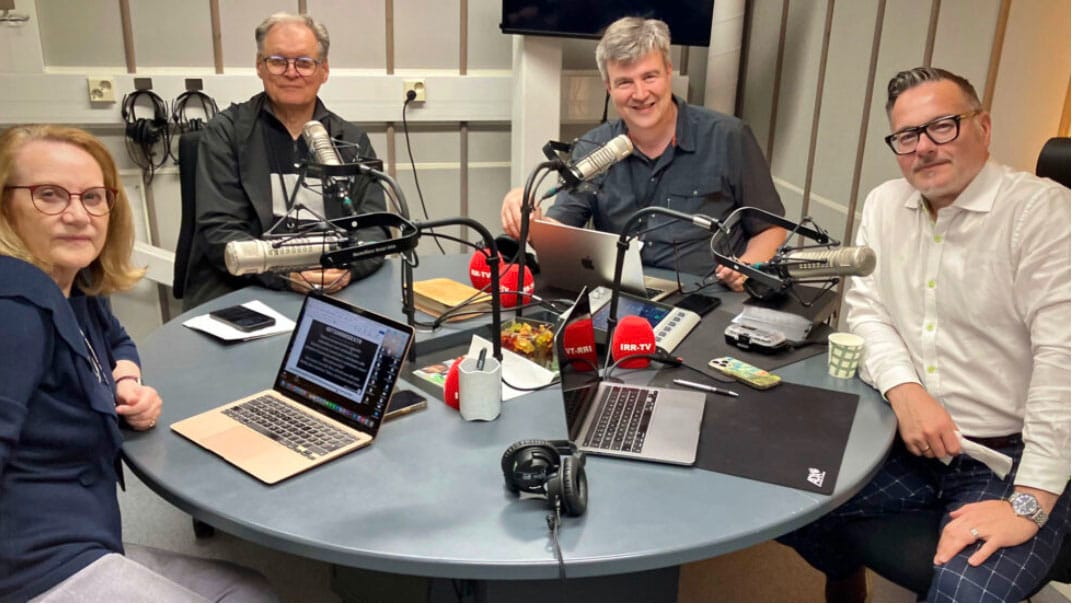
IRR-TV, a Finnish media ministry that has broadcast Christian programming in Russian for five decades, is marking its 50th anniversary this year. What began in 1976, when Hannu and Laura Haukka started producing Russian-language radio programmes from Austria, has grown into a multimedia outreach spanning television, satellite and the internet. The milestone will be celebrated in Kerava, Finland, on 26 September.
From its earliest days, IRR-TV focused on reaching people behind the Iron Curtain. The first Finnish-produced Russian broadcast went out on 5 September 1981 from a radio station in Portugal, recorded in the bedroom of an apartment in Katinala, near Parola. Within a few years, 11 international radio stations were carrying the Haukkas' programmes, at a time when religious activity in the Soviet Union was tightly controlled. The ministry was formally founded as IRR-TV ry in December 1989, and television soon joined radio; in the early 1990s the animated Bible series Superbook aired on Soviet Union Channel One and drew more than one million letters from viewers across the USSR.
Today the ministry reaches far beyond the former Soviet Union. In 2025, a digital campaign in Egypt featuring testimonies of changed lives drew more than 44 million views and reached at least 12 million people, while a local team held more than 25,000 personal online conversations. Last year the ministry produced around a thousand television programmes in Arabic, Farsi and Tajik, carried by 16 satellite channels across the Middle East, Africa, Asia and Europe. After Russia's 2022 invasion of Ukraine, IRR-TV ended its operations in Russia but continues Russian-language work from Finland, and in Ukraine it pairs media outreach with emergency aid, including the delivery of more than 20,000 heating stoves. “We have come a long way from the bedroom studio in Katinala to today's online campaigns,” said communications manager Mikael Ärling. “The technology has changed, but the goal is the same — to reach people across borders.”
(Originally published in Finnish. Summary translated by CC / Connexion.)
Source: Suomen Vapaakirkko / Suomen Viikkolehti — svl.fi


