
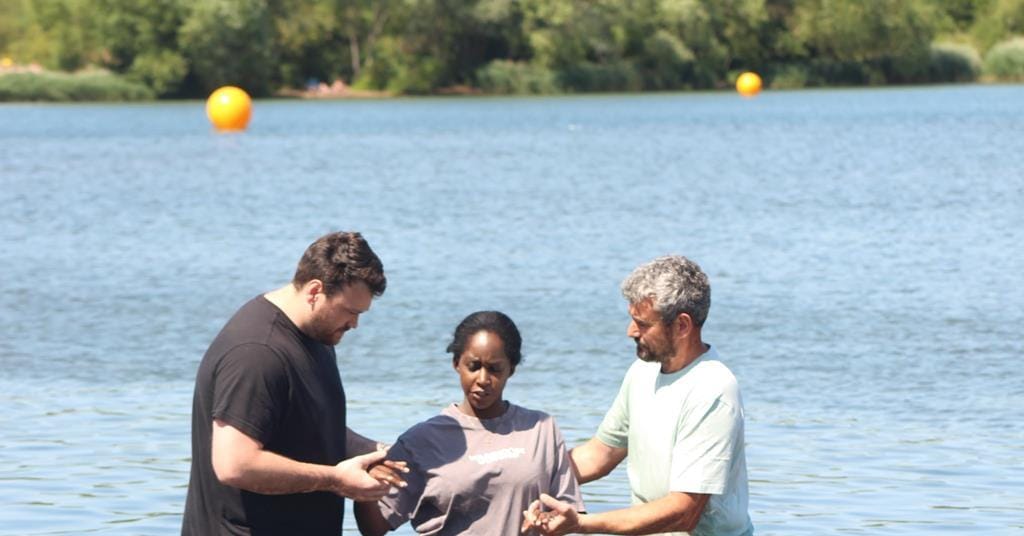
A growing number of churches across the United Kingdom are taking baptism out of the building and into open water. In the summer of 2025, around 1,000 people from five churches gathered on Bournemouth beach to witness 92 baptisms — a gathering that drew mainstream media attention, including positive reports on the BBC. A few months ago, 20 churches in Rotherham united for a mass baptism at Manvers Lake. And a few weeks ago, 170 people were baptised at Bigbury-on-Sea in Devon. Writing in Premier Christianity, the magazine’s editor Sam Hailes asks what these gatherings actually signify.
For Hailes the question is personal before it is analytical. He was ten years old, on Sunday 17 October 1999, when he told his parents he wanted to be baptised. His father, a church leader, wanted to be sure he understood what it meant, so he went through the obligatory baptism classes — and then the church went down to Felixstowe beach on the North Sea for the “dunking”, the day before his eleventh birthday. He remembers little of the day beyond the water temperature, but he has never forgotten what it represented, and he confesses to having teased Christian friends ever since whose baptisms took place in a comfortably heated indoor pool.
What he has found encouraging is the number of mass baptisms now taking place. At Bournemouth in 2025 it was five churches together. At Manvers Lake near Rotherham, 20 churches. The senior pastor of Liberty Church, Adrian Dexter, told Premier that their gathering had historical precedent: in AD 628, St Paulinus had baptised new converts in the nearby River Trent in the presence of King Edwin. “We have believed and prayed for many years that what the Lord did then, He will do again,” Dexter said — “that the rivers and lakes of this nation will once again host mass, public baptisms.” At Bigbury-on-Sea in Devon, people travelled from all over the country after Merlin Kraft, a Christian content creator, put the word out on social media: “No tickets. No charge. No booking. Just come.” They did. “The line just kept coming,” Kraft said. “I must have been in the water for well over an hour.” Gospel tracts and more than 100 free Bibles were also distributed to onlookers.
When the Bournemouth baptisms first made headlines, many cited them as evidence of a “quiet revival”. Hailes has never been convinced by that analysis. On his reading the story is instead one of Christian unity — almost any town or city in the United Kingdom could hold its own mass baptism, he suggests, if only local church leaders united, got their diaries out and made it happen. He offers just one piece of practical advice: don’t book it for October.
Source: Premier Christianity — premierchristianity.com


