
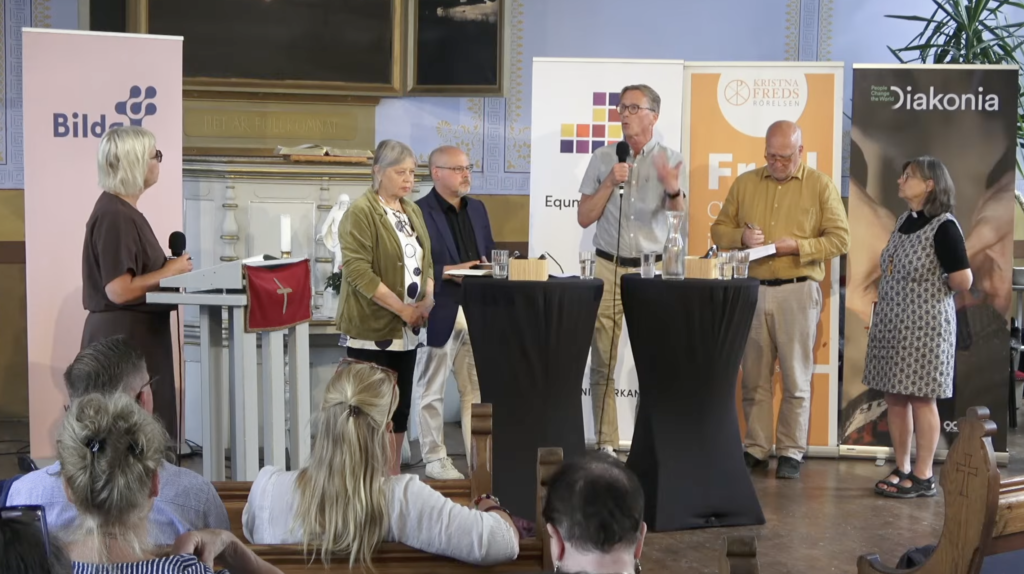
How far does intercessory prayer reach when people are living in the midst of war and occupation? That question framed a seminar on Israel and Palestine during Sweden's Almedalen Week, the country's largest annual political gathering held in Visby. The discussion moved beyond simply describing the situation in Gaza and the West Bank to asking what concrete tools churches already possess — and what responsibility they bear to use them. Three guiding questions shaped the event: "What do we know?", "How do we speak about it?", and "What do we do with that knowledge?"
A central example was the Ecumenical Accompaniment Programme (EAPPI), launched in 2002 at the initiative of churches in the region. International accompaniers live for three months alongside local communities in the West Bank, documenting the situation while their presence provides a protective function as people go about daily life — travelling to school, shopping, or working their fields. Karin Wiborn, Church Leader of Equmeniakyrkan, acknowledged that the war has made it difficult to maintain accompaniment on the ground, while cuts to state funding have worsened the financial outlook. "We are fighting hard to train accompaniers and hope to send them," she said. Morgan Johansson, foreign policy spokesperson for the Social Democratic Party, also called for Sweden to restore support for the programme.
Wiborn described how encounters with Christians in the region have challenged her own understanding of the church's task. "I feel unwell when I hear the priest and theologian Isak Munther say, 'We don't want to hear the prayers any more. We want action, we want action,'" she told the seminar. Magnus Walan, senior policy advisor at Diakonia, the Swedish ecumenical development agency, summarised the path forward in three words: financing, facts on the ground, and international law. For the global free evangelical family, the seminar underscored the growing recognition that prayer and presence must go hand in hand — and that churches have a distinctive capacity for sustained, personal solidarity that governments alone cannot provide.
(Originally published in Swedish. Summary translated by CC / Connexion.)
Source: Equmeniakyrkan / Sändaren — sandaren.se


