
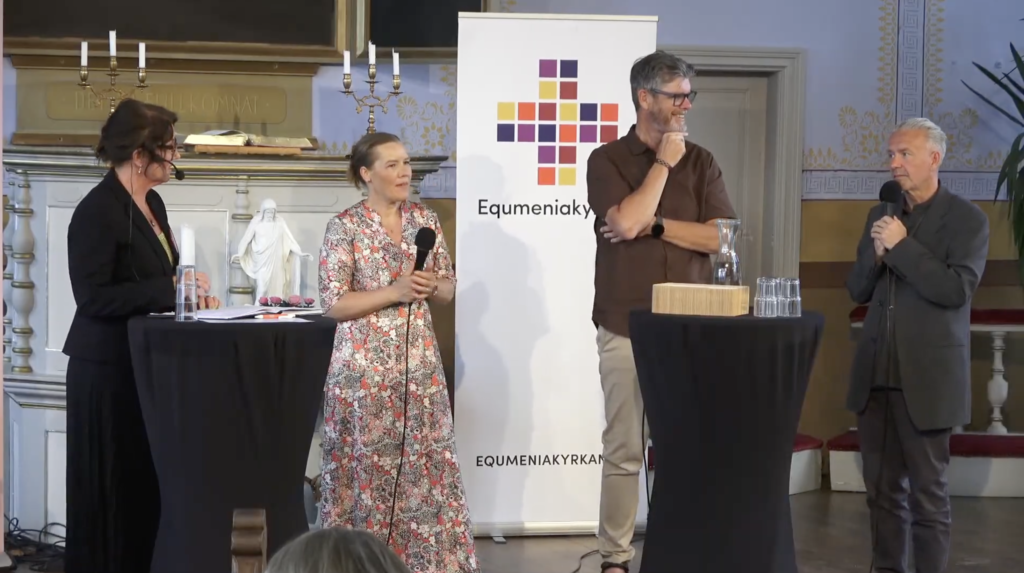
At Sweden's Almedalen political week, Equmeniakyrkan together with study associations Sensus and Bilda hosted a seminar exploring a question that resonates far beyond Swedish civil society: do today's movements need strong individual profiles to gain traction, or does the spotlight on personalities risk eroding the collective "we" that gives a movement its staying power? The discussion, held on 24 June in Visby, drew on the experiences of leaders from the church, non-profit, and educational sectors.
Almedalen Week is Sweden's largest annual political and civil society gathering, drawing thousands of participants to Visby on the island of Gotland each summer. Equmeniakyrkan — the Uniting Church of Sweden, formed in 2011 through the merger of three historic free church traditions — has maintained a consistent presence at Almedalen, using the forum to contribute a distinctly free-church voice to public conversations about democracy, community, and faith. Sändaren, the independent Christian newspaper that has covered Swedish free church life since 1905, reported on the seminar.
Emma Henriksson, secretary general of the non-profit umbrella organisation Famna and a former Christian Democrat member of parliament, captured the central tension: "Yes, it's you who is fronting — but you're not fronting yourself, you're fronting us." She observed that people have always sought out individuals who create trust and help them make sense of the world, but warned that a problem arises when a leader no longer represents anything larger than their own personal brand. Fredrik Hedlund, director of Sensus, raised the uncomfortable question he once put to two prominent Swedish church leaders: "What happens when you're no longer here?" Both, he recalled, returned to the same conviction — that whatever is built must never become dependent on the person standing at the front. Hedlund noted that while many first-time volunteers describe their experience as meaningful, surveys by Volontärbyrån show that few feel they are invited into a lasting community, warning that organisations risk "instrumentalising engagement instead of inviting people into a long-term 'we'." The panel included Kent Wisti, a Church of Sweden priest and artist, and the conversation was moderated by Sändaren's editor Carl-Henric Jaktlund.
(Originally published in Swedish. Summary translated by CC / Connexion.)
Source: Equmeniakyrkan / Sändaren — sandaren.se


