
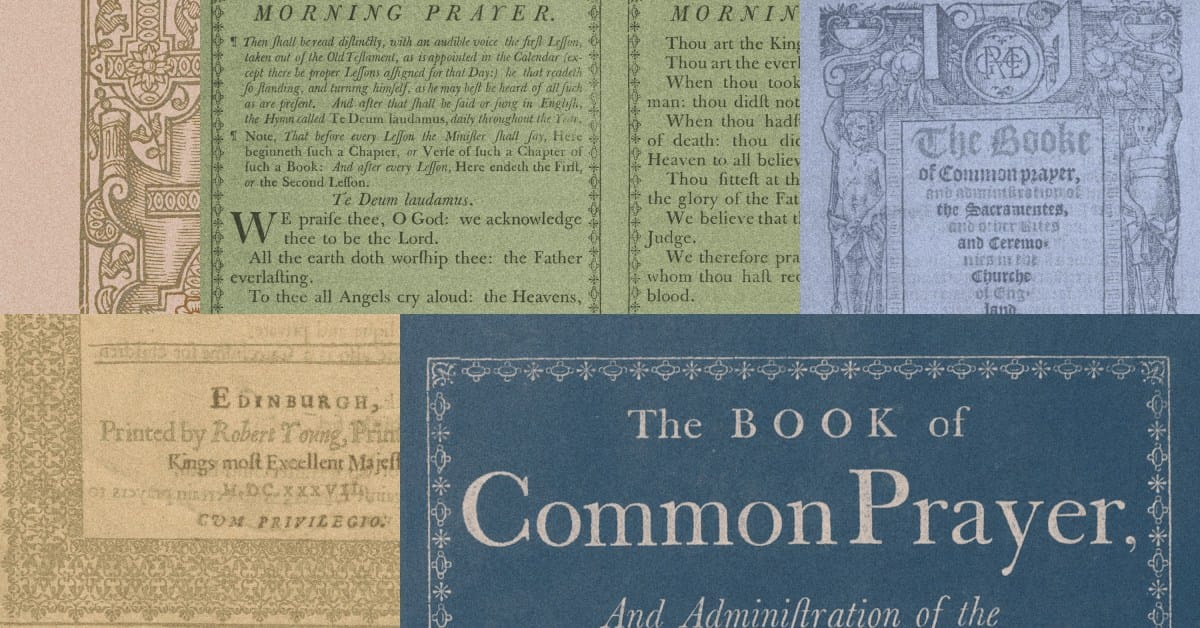
The Book of Common Prayer, the prayer book Thomas Cranmer compiled for the Church of England and published in 1549, is finding readers well beyond Anglican pews. Writing for Christianity Today, Haley Byrd Wilt describes a quiet boom among Christians from non-liturgical traditions who are turning to liturgy for its rootedness and depth.
Her opening example is the musician Andrew Osenga. About fifteen years ago a burst pipe flooded his family's house; they moved out for six months and lost everything they owned. With an infant and two other young children, he found himself at a Bible study in an Anglican church down the road, and then at morning services after dropping the older children at school — even though he belonged to a decidedly non-Anglican church. "I didn't understand what was happening," he recalled. "I was so depleted. … The liturgy works whether you have the energy for it or not. You can just enter into it as you need. … It was such a gift to me." He is now publishing his own set of prayer books, The Quiet Hours, three volumes of morning and evening prayers with Old and New Testament readings, drawing on Catholic monks, Anglicans, Lutherans and others. "I don't know how copyright works," he said, "so every prayer is really old."
He is not alone. Douglas McKelvey's Every Moment Holy series, which offers prayers for ordinary circumstances from changing nappies to being overwhelmed by too much information, has sold more than 300,000 copies according to its publisher. Claude Atcho's Rhythms of Faith introduces the church calendar; Tish Harrison Warren's Liturgy of the Ordinary commends practices for everyday life. Ashley Tumlin Wallace, a children's minister at an Anglican church in the Florida panhandle, writes about feast days, saints and observing the liturgical seasons, and estimates that half her readers are, like Wilt, "nonliturgical, really hungering for liturgy and more of the historical traditions in their life." Wallace fell in love with the prayer book as a young mother. "I needed more meaning in my day," she said. "The Book of Common Prayer gave me a structure to my day and a way to teach my children how to pray when they wake up or before they go to bed."
Wilt is not Anglican either, and has used the book for about a decade. She is particularly fond of the evening rites — "Lighten our darkness, we beseech thee, O Lord; and by thy great mercy defend us from all perils and dangers of this night; for the love of thy only Son, our Savior Jesus Christ" — paired with the Scripture readings chosen for nighttime, which she says help her combat what she calls her own twilight derangement. She notes that the book's original purpose was not aesthetic. According to Alan Jacobs's history, one of Cranmer's chief reasons for compiling it was "to provide a venue in which the Bible could be more widely and more thoroughly known," at a time when most ordinary people were not familiar with the Scriptures.
The appeal reaches into free-church congregations. Wilt's own church, affiliated with the Evangelical Free Church of America, sometimes reads prayers and confessions from the Book of Common Prayer aloud; she recounts a Baptist pastor who visited a liturgical church as a guest preacher and was so struck by the confession that he added a version of it to his own services. Andrew Hagen, her church's worship leader in Washington, DC, sees the interest as part of a "greater movement amongst Western Christians, particularly those who grew up in evangelical backgrounds," to "look for things that are established and written outside of ourselves." Older texts, he said, "have more of an opportunity to work on us and to exist outside of our modern Western bias."
Wilt is careful about the terms of the recovery. Traditionalists may cling to thees and thous and distrust modern adaptations, and she notes that new liturgies succeed insofar as they keep Scripture at the centre rather than merely reproducing archaic language. The artist Stephen Crotts, who first met the prayer book about twenty years ago while watching the film Master and Commander, was struck by the burial-at-sea prayer and its reference to Revelation 20:13, the sea giving up its dead — and by the resurrection of the body, an idea he had never encountered. The church calendar, he told her, gives a way into kairos, presence, "an upward cycle of feasting and fasting," against the flat timeline of modernity. What the book offers, on this account, is not a style of worship but a form that keeps returning its users to the words of Scripture.
Source: Christianity Today — christianitytoday.com


