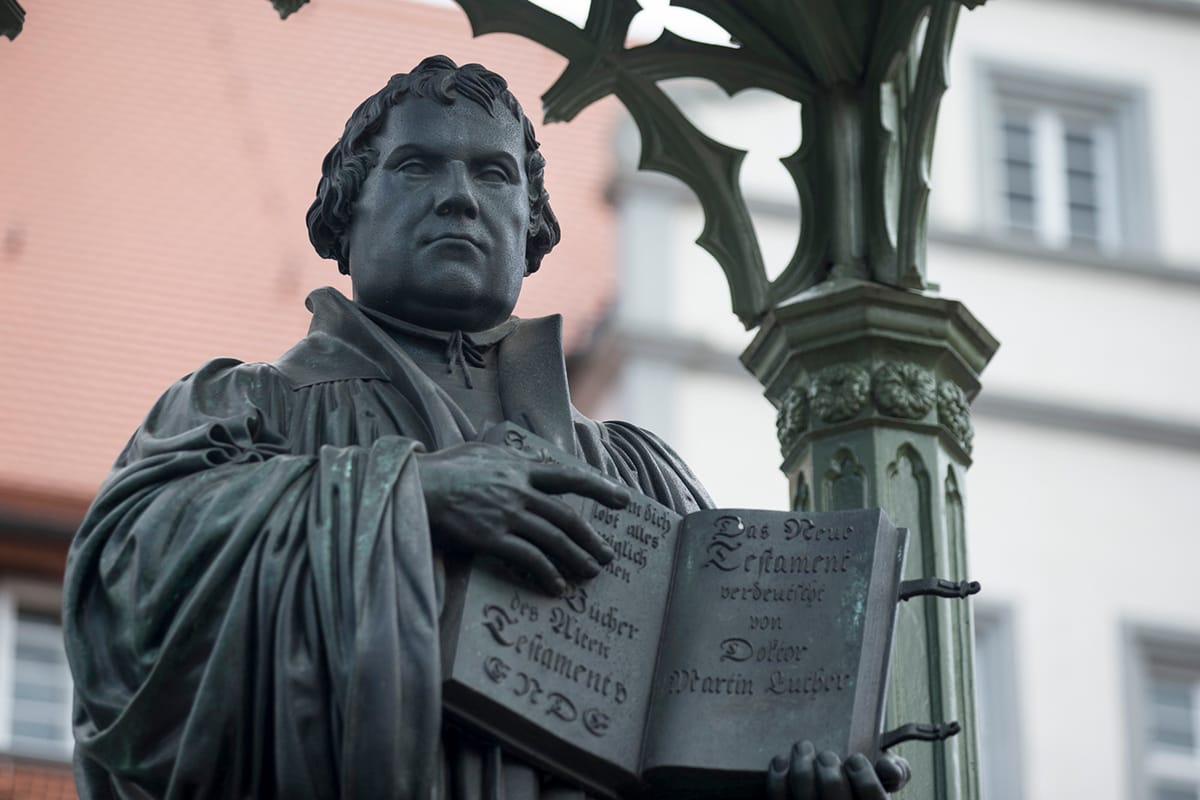
Protestants are often assumed to have cut themselves loose from the first centuries of the church — to have started again from Scripture alone and left the Fathers behind with the rest of the medieval inheritance. Nicholas Needham argues that this is a misreading of the Reformation itself. The Reformers, he writes, were disciples of the early church fathers, and they understood their work as recovery rather than invention. “Our agreement with antiquity is far closer than yours,” John Calvin told Cardinal Jacopo Sadoleto in 1539. Luther belonged to the Augustinian order of friars; Calvin appealed to Chrysostom and Basil among the Greeks, and to Cyprian, Ambrose and Augustine among the Latins, as witnesses to “that ancient form of the church.”
Needham, who lectures in church history at Highland Theological College in Dingwall, Scotland, spends much of the essay simply explaining who the fathers were. The name is given to significant leaders and writers of the first few centuries, with historians setting the boundary anywhere from the first 300 years to the first 600. It is not a label for every early Christian writer: it was reserved for those received as sound and reliable teachers, which is why Tertullian and Origen — two of the most influential theologians of the third century — are often not counted among them. He also recovers the setting that shaped them. For their first centuries Christians were a despised minority in a pagan empire, always liable to persecution. Quoting the second-century Epistle to Diognetus, he describes a people who “live in their own countries, yet as pilgrims,” for whom “every foreign land is to them their native country, and every birthplace as a land of strangers.”
What the church received from them is not a matter of antiquarian interest. The doctrines of the Trinity and the incarnation were “first hammered out by the fathers on the fierce anvil of controversy,” as Needham puts it. Athanasius of Alexandria spent seventeen years in exile for defending the deity of Christ; Calvin later called him “the principal defender of the orthodox faith, a divine writer worthy of immortal praise.” The Nicene Creed, finalised at Constantinople in 381, and the Creed of Chalcedon, produced in 451, remain for Protestants “the gold standard of a right biblical interpretation” of the triune God and the two natures of Christ. Needham is careful about the limits too: “They were not infallible; but after the prophets and Apostles, they were truly our fathers in the faith.”
For the free evangelical tradition the argument has a particular edge. Free churches have no bishops, no magisterium and no single authoritative teaching office; their confessional identity — the Trinity, the incarnation, justification by faith — is an inheritance received through the Reformation from the ancient church, not a private discovery of the sixteenth century. Read in that light, the fathers are not a step toward Rome but part of the common ground the Reformers claimed. The Diognetus description of Christians as resident aliens, at home everywhere and nowhere, also speaks directly to a believers’-church instinct: a community defined by its allegiance to Christ rather than by its place in the structures of the surrounding society. Needham’s closing point is modest and practical. If we are Protestants, that very fact, he says, should give us a bias toward knowing the early Church Fathers.
Source: Christian Post, “What should Protestants know about the early Church Fathers?” by Dr Nicholas Needham, 18 November 2026. The article was first published in Tabletalk, the magazine of Ligonier Ministries.


