
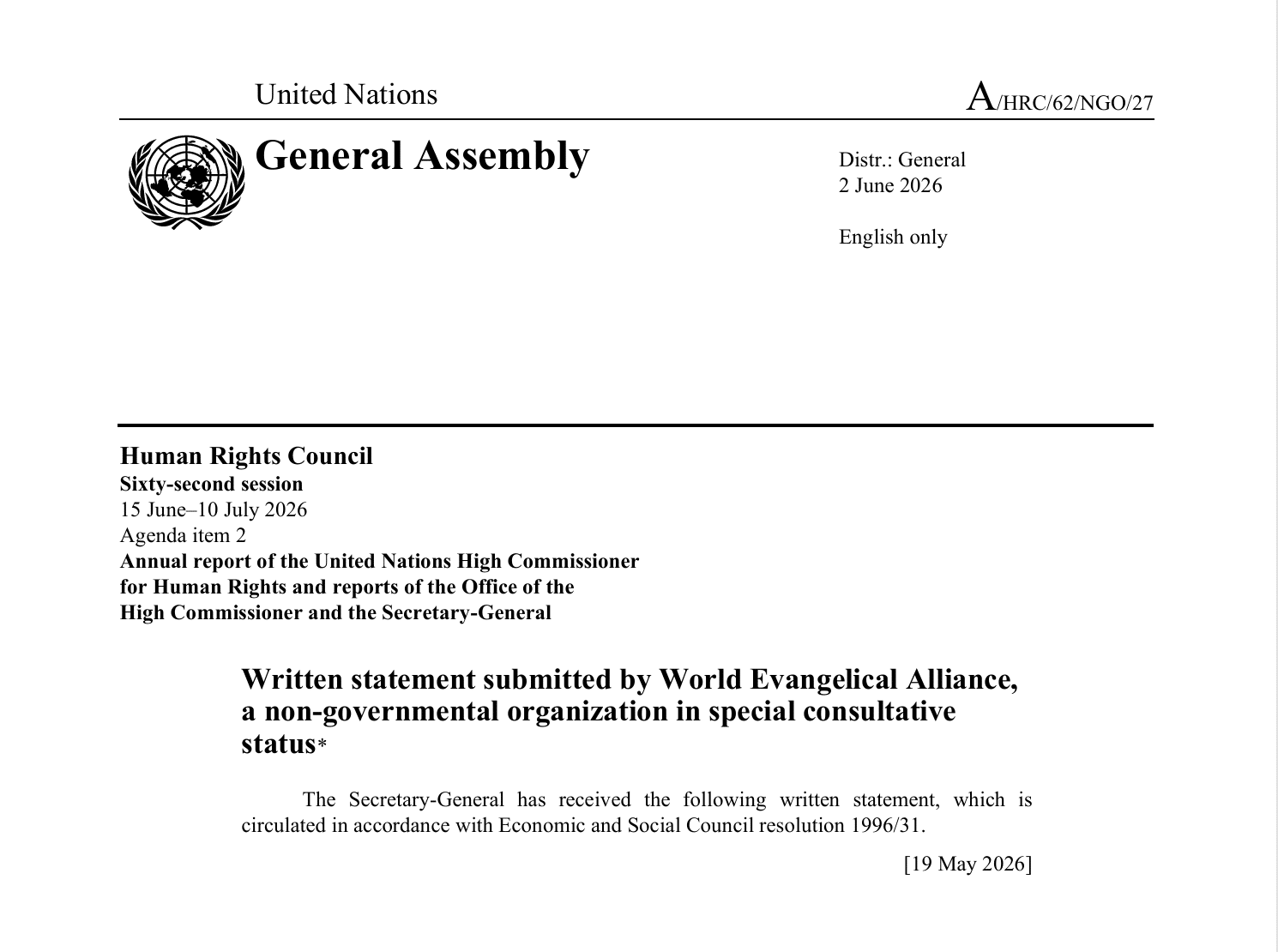
The World Evangelical Alliance has submitted a written statement to the United Nations Human Rights Council during its 62nd session, drawing urgent attention to sustained violence against Christian communities in India and Nigeria. The statement, dated 16 June 2026, documents killings, mass displacement, and the destruction of livelihoods in both countries, and calls on their governments to take concrete measures to protect affected communities and ensure accountability for perpetrators.
In India's Manipur region, ethno-religious tensions that erupted in 2023 have continued to produce a climate of fear and instability, with the WEA specifically documenting the killing of church leaders. In Nigeria's Middle Belt, predominantly Christian farming communities have faced repeated attacks leading to deaths and mass displacement. The WEA acknowledges the complexity of the Nigerian conflict — driven partly by competition over land and resources, environmental pressures, and the proliferation of armed groups — while underscoring the severe humanitarian toll. For the global free church family, these regions are far from abstract: IFFEC member federations in India, including the Evangelical Free Church of India and the Hindustani Covenant Church, operate in contexts where such violence directly affects congregational life and Christian witness.
The WEA framed its submission within the annual report of the UN High Commissioner for Human Rights, urging the UN office to strengthen monitoring and reporting on freedom of religion or belief violations and to enhance engagement with the governments concerned. The statement reaffirmed the Alliance's commitment to "advocating for human dignity, justice, and the protection of fundamental freedoms." Beyond the UN process, the WEA called on both governments to pursue long-term solutions through dialogue and peaceful engagement rather than relying on security measures alone — a recognition that sustainable peace in both regions requires addressing underlying grievances alongside the urgent task of protecting vulnerable communities.
Source: World Evangelical Alliance (WEA) — worldea.org


